OUR WATERSHED

In any case, when a man must be afraid to drink freely from his country’s rivers and streams that country is not longer fit to live in. ~ Edward Abbey, 1968

Spending time in Atlanta, in February 2019, I ponder living in a concrete world. Rain poured earlier in the week and runoff gushed out of holes cut into the cement walls next to the sidewalks. Rain traveled through an impervious world finding ways to flow on its unnatural course creeping into the flat in the old building we were renting. Brown water, garbage and sediments advanced and effused into storm drains. Do people in urban areas think about the water that easily flows from pipes in their businesses or homes?

It is not just city dwellers who may take water and other natural resources for granted...it is the miner and CEO of industry...it is the farmer and rancher...it is the construction worker...it is the recreational water user...it is all of us. How do we achieve harmony with nature and live within its scope in a world that chooses the need to pursue goals of economic development and advanced technologies?

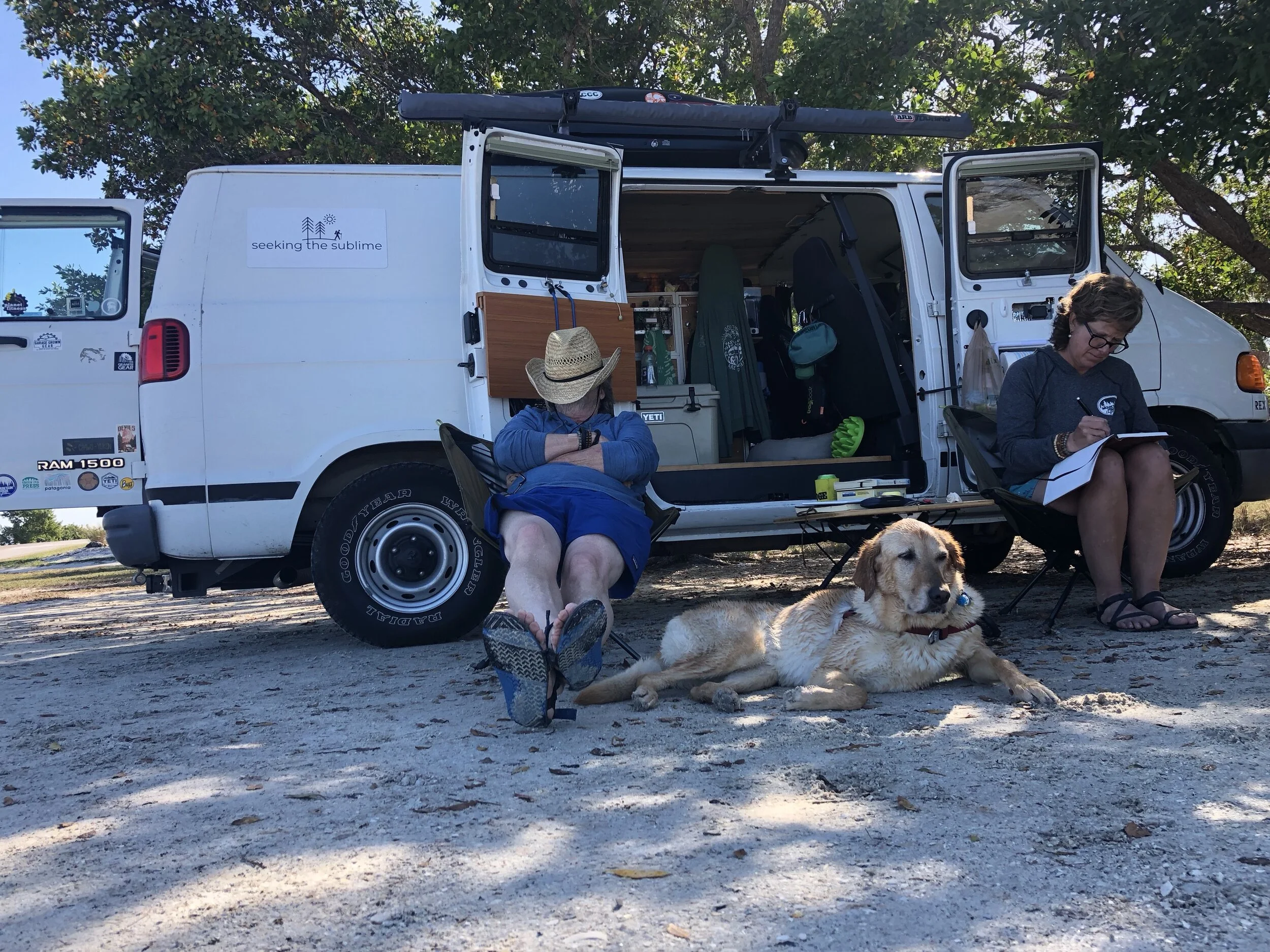
On June 1, 2018, my husband, Jim, and I began our nomadic journey away from the “American Dream” and outside the traditional paradigm of how people live. Author and co-founder of the Dark Mountain Project, Paul Kingsnorth, describes “withdrawing from the fray” in his book Confessions of A Recovering Environmentalist and Other Essays. Kingsnorth continues, “Withdraw [ing] not with cynicism, but with a questing mind. Withdraw[ing] so that you can allow yourself to sit back quietly and feel - intuit - work out what is right for you, and what nature might need from you. Withdraw[ing] because refusing to help the machine advance - refusing to tighten the ratchet further - is a deeply moral position.” Jim and I wanted to explore, discover, and learn from and about the environment and humanity. So, we embarked on our adventure.

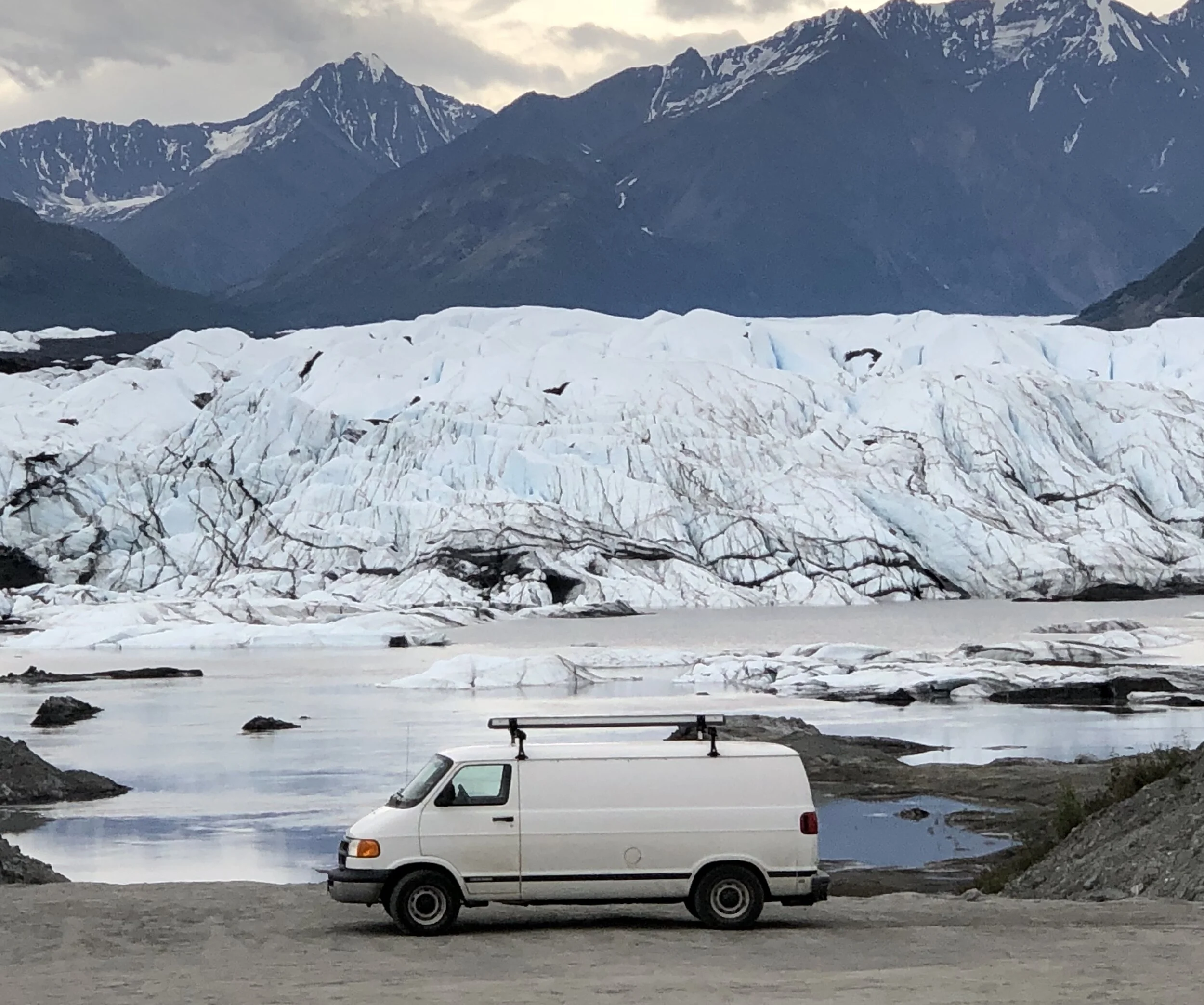
Our first travel quest took us to Alaska via the Alaskan Highway through Alberta, British Columbia, the Yukon and into Alaska. Driving to Alaska is remote. We were elated to see the dramatic mountains, awe-inspiring glaciers and diversity of wildlife along the way. We observed a mother bear and her three cubs playing in a field, saw our first porcupine, and made a u-turn to see a herd of caribou. At the same time, we were distraught to see the countless turnouts and roads cut through the wilderness to provide access for timber and mining trucks and heavy equipment. We also warned our family and friends that we may not have cell service due to our remote locations. Surprisingly, we did have service. Cell towers loomed above the landscape throughout much of the Alaskan Highway.

Alongside the man-made turnouts and cell towers on the Alaskan Highway, blemishes continued to arise in this remote landscape - large plots of naked land exposed to the elements where maybe a mosaic of trees once stood...and plastic pipes extending out of rivers and streams. I wondered...are these pipes pumping water out or sending waste into the streams and rivers? Who is monitoring these operations in such a remote area? My contemplations around this strip of environment provoked emotions and questions pertaining to our connections to nature. I was awakening to the truths around the atrocities committed against our environment and at the same time, seeing the beauty and diversity existing in nature. In Arctic Dreams, Barry Lopez describes the men working for the oil companies in Alaska. He shares, “...the world seemed on balance...or at least well intentioned. Part of what was attractive about these men was that their concern for the health of the land and their concern for the fate of the people were not separate issues...the fate of each hinged on the same thing, on the source of their dignity, on whether it was innate or not...” We can only hope “these men” along the Alaskan Highway had concern for the health of the land” and “concern for the fate of the people.”

We found on our journey that there are people “concern[ed] for the fate of the people.” Our first experience observing this concern for our environment happened on our resupply in Whitehorse, Yukon on the way to Alaska. We visited the local farmer’s market and noticed a banner with the slogan Protect the Peel. We inquired. The college intern working the booth explained the ongoing debate and history centering around the Peel Watershed. She explained that the Peel Watershed is one of the few pristine watersheds left in North America. The debate stems from the threat of mining and industry degrading the watershed of First Nations Peoples in the Yukon who hunt, fish and subsist off the land. These indigenous people who desire to live in harmony with the watershed and protect it for future generations. This brief conversation began my thirst for more knowledge around mining and watersheds. As we traveled through Alaska and back to the lower forty-eight states, we began to notice more and more evidence of debates around mining and watersheds. These observations were just the beginning of a recurring theme, our watershed.

****

In August 2018, we returned to the lower forty-eight states and landed in one of a few, cooler temperature spots we could find - Telluride, Colorado. As fate would have, I stepped into a local bookstore and eyed a book titled River of Lost Souls by Jonathon Thompson. I purchased the book to read and noticed a flyer next to the register: Author Talk with Jonathon Thompson at the Telluride Library on Sunday.

From Thompson’s lecture and book about the Gold King Mine near Silverton, Colorado, my thoughts were saturated with facts about abandoned mines and mining and the history and cost of natural resources and lives. I learned about tailings and acid drainage and what happens when an abandoned mine sits and leaves its “scarred history” on future generations. I learned how communities are willing to give up an entire watershed to economy. I learned the Navajos living in the San Juan Mountain region are afraid to use “their lands” on the Animas River for farming because of the unknown toxins permeating the ground and crops. I learned about the damage done to the land and the toxins and metals released into ground water that never really go away. I learned how industry throws around phrases like “treating water into perpetuity” when these mining companies cannot cost effectively make such a commitment. I learned that the Gold King Mine was a crisis to the people along the Animas River. However, the Gold King Mine incident is just one event - similar events occur repeatedly where mines have been abandoned, seeping toxins into ground water.

Spending a second week in Telluride, CO in the summer of 2019, I read an article about the restoration of the Delores River in Rico, CO. In the 2019 article, “Letting Nature Take Its Course” by Deanna Drew, she explains an experimental restoration project being conducted in Rico, CO to help control acid drainage from past mining in this area. Drew writes that the Rico community alerted the Environmental Protection Agency (EPA) to the “thick orange mineral sludge containing dangerously high levels of heavy metals” in 2011. According to Drew, the EPA ordered the Atlantic Richfield Company “to clean up the site and identify a long-term management solution for the tunnel’s perpetual flow.” Drew states that the scientists and engineers involved in the cleanup, observed that downstream of the mine existed a natural, riparian area with a healthy wetland.The scientists and engineers decided to use an experimental, restoration approach to stabilize one section of the Delores River using a “new passive wetland treatment.” The new process utilized natural materials to reduce metals in the water. The article stated that the passive wetland treatment system is showing a decrease in the metals. However, the article also stated that the wetlands will need to be “monitored and maintained for the foreseeable future...solids will still need to be dredged and wetland plants will need to be added and replaced.” The article claimed this natural restoration approach was more cost effective than the traditional treatment which treats the sludge as it drains into water ponds. Both approaches cost millions of dollars and need management. So, is this new natural approach really restoring? Or is it simply a perpetual, toxic garden to be constantly replanted and managed? Is either treatment truly sustainable?

****

For the next several months and into our second year on the road, we continued to witness more and more community efforts to protect and restore water quality and watersheds. Many communities and the people inhabiting them are thinking about nature close to home. There are many examples of local coalitions throughout North America trying to promote healthy watersheds and educate the public. One example of a community thinking about its watershed is Crested Butte, CO. To Protect and Restore is the motto for the Coal Creek Watershed Coalition in Crested Butte, Colorado. We found the following sign at a firewood box outside of town in June 2019:
Suggested donation of $5 for 7 pieces of firewood goes directly to the funding of portable toilets placed at camping spots in the surrounding valleys. These toilets are placed by the Coal Creek Watershed Coalition, a local non-profit organization dedicated to protecting Crested Butte’s local watersheds since 2004. Human waste in the back country and thus in our rivers and streams is becoming a major problem and health hazard. Please help fund the toilets you will be using tomorrow morning after a tasty cup of coffee. Please enjoy this beautiful place and help us preserve for future generations.

We also talked to locals who described the debate in Crested Butte around No to the Brush Creek Monstrosity. People in the Crested Butte community bonded to reject a 240-unit housing development that would not have sustainable access to water and would pollute local streams.

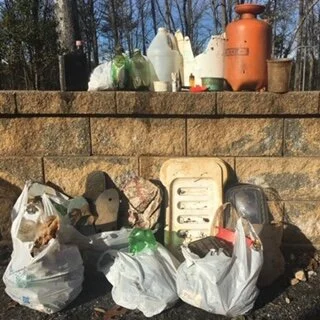
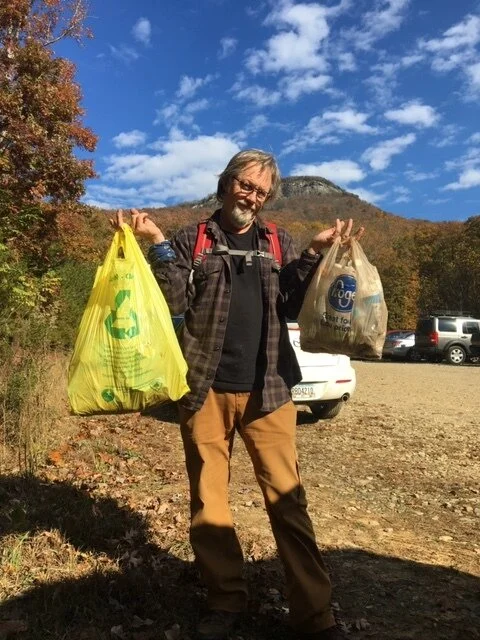
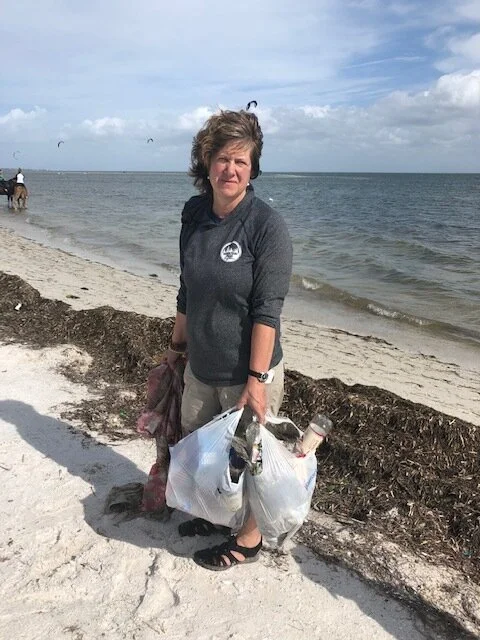
All of the community efforts we observed made an impact on my thinking and actions. I reflected on how I can help in the efforts to protect watersheds. Of course, Jim and I bought the firewood to support the Crested Butte coalition. But what else could I do as an individual to help? One effort I have consistently done for about fifteen years - pick-up trash. I recall the amount of plastics and trash we picked up in December 2018 while watching windsurfers near Tampa, Florida. One surfer told me that the amount of plastics we see occurs each day on this beach! He stated that most of the plastic is washing up from other places. We continued to pick up trash around lakes, on trails, and in campgrounds as we travel.

After reading Susan Freinkle’s Plastics: A Toxic Love Story, I began thinking about my use of plastics and how, at least, to limit the use. I had already stopped using plastic straws. And I am mindful when purchasing plastics. Limiting the use of plastics is hard. We are inundated with plastics in our world. What else can I do? I began educating myself about watersheds and completed the EPA’s Watershed Academy modules and read more books about our environment written by a variety of authors (see list of books at the end of this blog).

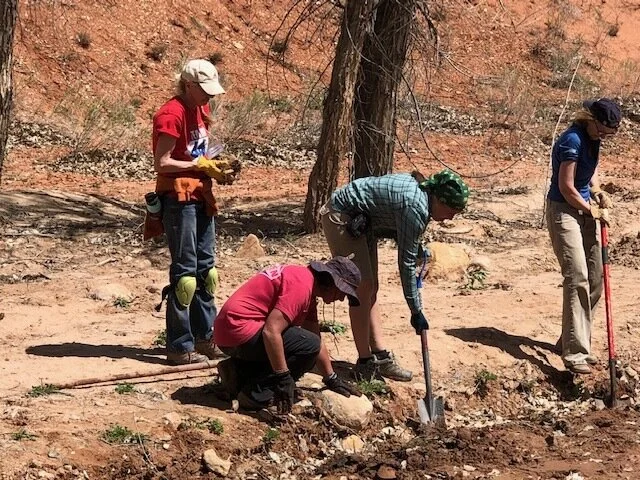
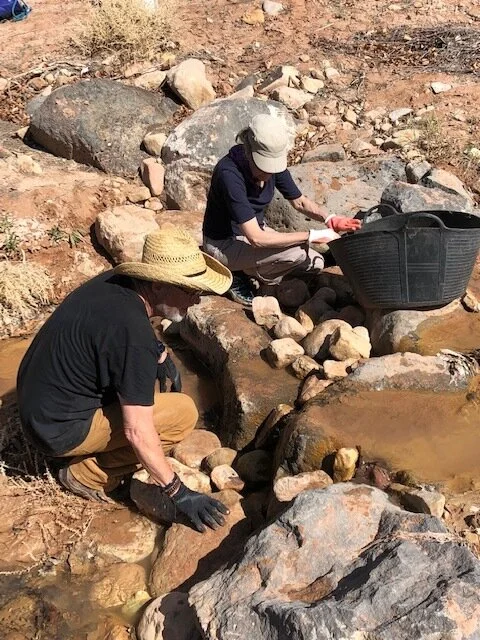
Then, in April 2019, we happened upon one of my favorite experiences on our travels. On a lark, Jim directed us to Ghost Ranch to camp, hike and just be where Georgia O’Keefe painted many of her desert landscapes. At the visitor center, there was a flyer asking for volunteers to help the Keystone Restoration Ecology group and the volunteers from the BioPark in Albuquerque, New Mexico with the Ghost Ranch Watershed Restoration Project. We decided to extend our stay at Ghost Ranch so we could volunteer for the project. Jen and Steve from Keystone Restoration Ecology explained to the volunteers about the power and intensity of the 2015 flash flood and the restoration efforts to correct the meander in the Chama River in order to slow the flow of the water. According to Steve, ranchers and farmers in the late 1800’s and early 1900’s changed the flood plain in this area through poor agricultural practices - building up land to farm and graze animals.

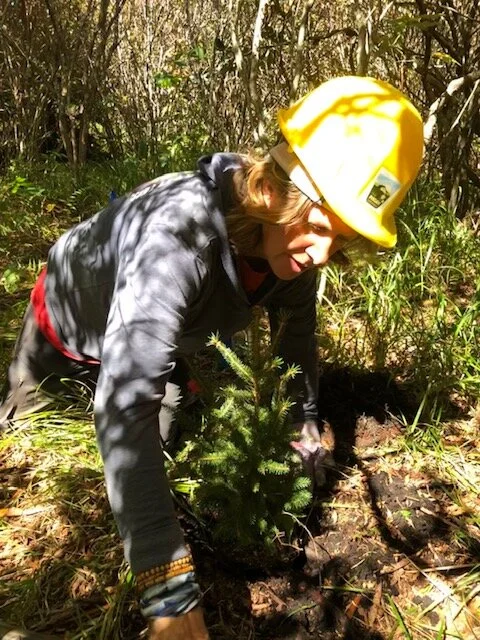
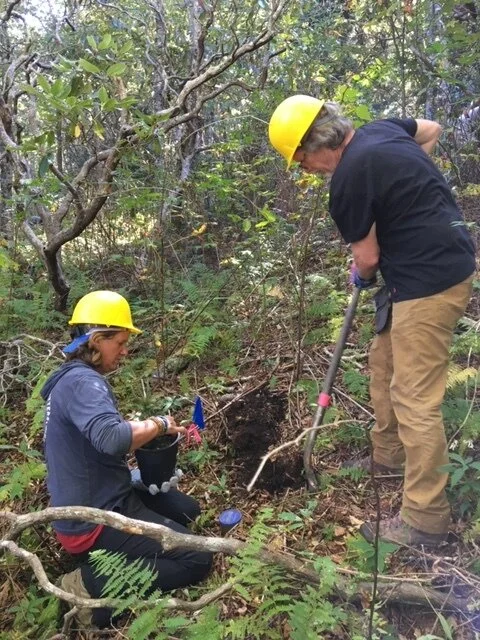
Steve and Jen described the flood of 2015 as devastating - destroying buildings on the Ghost Ranch property, leveling the vegetation, moving boulders and bringing sediment that changed how the Chama River flowed. The project goal is to level the sediment, use existing rocks and boulders in order to slow down the water, replant the riparian zone plants, wetland plants and bank plants and try to recreate the original flood plain as much as possible. Listening to Steve and Jen discuss the river and the watershed and gaining hands-on experiences of cutting and planting willow shoots, moving and placing large rocks to redirect the water to form a different meander in the river, and shoveling clumps of wetland plants to restore the river banks was enlightening. The “book knowledge” I received from the EPA’s Watershed Academy coupled with this hands-on experience and the knowledge of Jen and Steve expanded my learning about watersheds and restoration.

This experience at Ghost Ranch fueled my desire to learn more about watersheds and anything water. Through more reading, traveling, and observing, I was shocked to learn in urban cities like Flint, Michigan and Baltimore Maryland, problems of lead pipes continue to exist contaminating drinking water resulting in poisoning children and sickening adults. Also, in urban areas, construction site runoff and the amount of impervious cover create more and more runoff sending heavy sediment loads into streams and ground waters changing its natural course and increasing flood risk. In Amity, Pennsylvania, fracking pushes toxic metals into the ground water seeping into well water people need to survive. In Eastern North Carolina where my family lives, turkey and hog houses send waste into surface water sources and ground water. A percentage of these same fecal wastes are allowed to fertilize crops adding more waste to surface and ground waters. In Amarillo, Texas, large feedlots dump manure producing extra nutrients from cows and other animals into surface water seeping into ground water. In agricultural and rural communities throughout North America, nutrient runoff from fertilizers, manure storage and septic systems add excess nitrates and phosphorous into water sources producing dangerous levels of algae and increasing the risk for eutrophication depleting oxygen from ponds and streams killing the native species. In coastal areas, high salinity and brackish waters are creeping inland due to rise in ocean levels. All of these water pollutants degrade and change the natural watershed.

According to the National Oceanic and Atmospheric Administration, a watershed consists of a land area that channels rainfall and snowmelt to creeks, streams, and rivers and eventually to outflow points, such as reservoirs, bays, and the ocean. However, I prefer explorer, John Wesley Powell’s watershed definition, “that area of land, a bounded hydrologic system, within which all living things are inextricably linked by their common water course and where, as humans settled, simple logic demanded that they become part of a community.” The majority of watersheds in our communities are degraded due to pollution, dams, and/or other man-made structures blocking or slowing natural flow. Have we crossed a boundary where natural watersheds have evaporated? Are we solely dependent on technologies to have access to safe water?

According to the EPA’s Watershed Academy, there are point and non-point water pollutants. The EPA defines point source pollution as a single, identifiable source such as a sewage treatment plant. Since the establishment of the Clean Water Act in 1972, point source pollutants for surface waters are “more” regulated. The point source polluter must retain a permit with load allocations stating how much of a certain toxin or pollutant a water source can hold. This permittee then monitors the load allocation through a self-monitoring reporting system. How sustainable is quality water if we allow load allocations for a variety of toxins to be dumped into our surface waters? Do we trust those that are self-monitoring and self-regulating toxins entering our waters?

Non-point pollutants are much harder to regulate and according to the EPA are the number one cause of water pollution. Two examples of non-point water pollutants are agricultural and urbanization activities. Grazing animals may cause an increase in nutrients in the runoff through manure and fertilizers into water sources. These excess nutrients end up in streams, rivers and ground water. In urban areas, construction sites may cause extreme runoff and sediment disposal if not properly managed during a rain event. Non-point pollutants usually come from runoff from varied sources which bring sediment, nutrients, and other human-made pollutants into rivers, wetlands, lakes, streams and ground waters. There is no monitoring system for non-point pollutants - just suggested “best practices.” Communities can educate water users around these best practices.

****

While reading the material in the EPA Watershed Academy, I found it unsettling that the term “ecosystem service” was broadly used. I contemplated the word “service” attached to natural resources. I decided that Mother Earth cannot continue to benefit us when our decisions revolve around a capitalist society. We can no longer preach the word sustainability when we are past the sustainable mark. We cannot defend our current practices and protect our future. Rachel Carson’s words in her book, Silent Spring, published in 1962 haunt me -we are “moving on a faster trajectory than mankind’s sense of moral responsibility.” The machine is advancing and most of us are caught in a careless indifference. Maybe we cannot fathom ideas as immense as climate change, water wars, famine, overpopulation...Some of us feel we are immune to the suffering and hide in our consumerism and technological haze.

Rachel Carson suggested in 1962 that “the public” is not aware of true environmental issues because economics drive our society. In our social media driven world, we are aware. We are all witnesses. We are flooded with images and debates centered around poisoned waters, species extinctions, melting glaciers, rising ocean waters and plastics floating in our waters. We know the truth. We know industry and capitalism run our country. We crave it all and desire more. We do not want less. Our selfish desires hinder our ability to see who we are - humans dependent on things that drain and kill our natural resources.We are steeped in our self-centered world governed by those who choose sides around politics and economics. We are not basing decisions on humanity and the realization that natural resources are not here to “serve” us. For me, humane decisions start with clean and affordable water for all. The battles over water are already in motion over the Colorado, Nile, Jordan, Ganges, Euphrates and Tigris Rivers. Water wars encompass issues concerning access to safe, quality water due to climate change, over population, and economic boundaries. How do we stop a course already set in motion?

Clean Water Act and the EPA suggest protecting the water from its source - the watershed. The EPA is only responsible to “help” monitor and regulate point source pollutions and surface waters. Many ecologists believe a wholistic approach to restoring and maintaining the watershed is the key to quality water. In the United States, it is the responsibility of each state to monitor and regulate watersheds. In reality, it is up to each community and its citizens. In Plastic: A Toxic Love Story, Susan Freinkel comments, “The greatest threat to our planet is the belief that someone else will save it.” We all have a moral responsibility to make hard choices. Choices as simple as turning off the water when we brush our teeth or not using a plastic straw to bigger moral choices of decreasing or not buying overproduced chicken and beef or over developing land with no natural water source. We can research and find companies thinking about how to reduce water consumption while making their products or recycling the existing plastics (check out adidas.com and arvingoods.com).

We count on hope. Hope only lies in each of us to make a difference in small and big ways and to take care of the natural resources closest to us. I will continue to pursue volunteer activities that help the environment wherever my backyard is these days. I will be mindful of the best practices I know to help with water pollution. I will continue to think through my use of plastics and my consumption of products that use water wastefully. Just like a river sculpts the land, each of us need to carve out our own choices, moral responsibilities, and voice for Mother Nature to keep our selfish desires from further dilution of the natural world for our future generations. But, is there time to make changes? Who will do it? It is not just up to the youth of today to think about the future Earth. Everyone must act now.

To you the earth yields her fruit, and you shall not want if you but know how to fill your hands. It is in exchanging the gifts of the earth that you shall find abundance and be satisfied. Yet unless the exchange be in love and kindly justice it will but lead some to greed and others to hunger. ~ Kahlil Gibran, 1923

****

Selected Bibliography

     Abbey, Edward. Desert Solitaire. New York: RosettaBooks, LLC, 1968.

     Carson, Rachel. Silent Spring. New York: Houghton Mifflin Harcourt Publishing Company, 1962.       

     Drew, Deanna. Letting Nature Take Its Course. San Juan Skyway Visitor Guide Summer/ Fall, 2019.  Published May 2019.  

     Freinkel, Susan. Plastic: A Toxic Love Story. New York: Houghton Mifflin Harcourt Publishing Company, 2011.

  Gibran, Kahlil. The Prophet.

     Kingsnorth, Paul. Confessions of  A Recovering Environmentalist and Other Essays. Minneapolis, MN: Graywolf Press, 2012.

     Lopez, Barry. Arctic Dreams. New York: Open Road Integrated Media, 1986. 

     Thompson, Jonathan. River of Lost Souls. Salt Lake City, UT: Torrey House Press, 2018.

     Watershed Academy Modules (EPA)

Listing of Community Efforts Around Watersheds We Observed (So Far):

Protect the Peel (White Horse, Yukon)

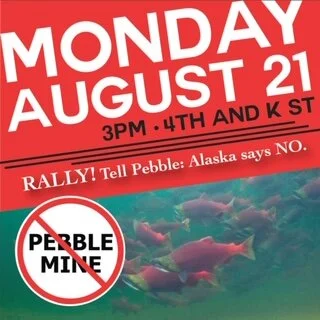
No To Pebble Mine (Near Bristol Bay, Alaska)

San Miguel Watershed Coalition (Telluride, CO)

French River Watershed Protection Advisory Committee (Tatamagouche, Nova Scotia)

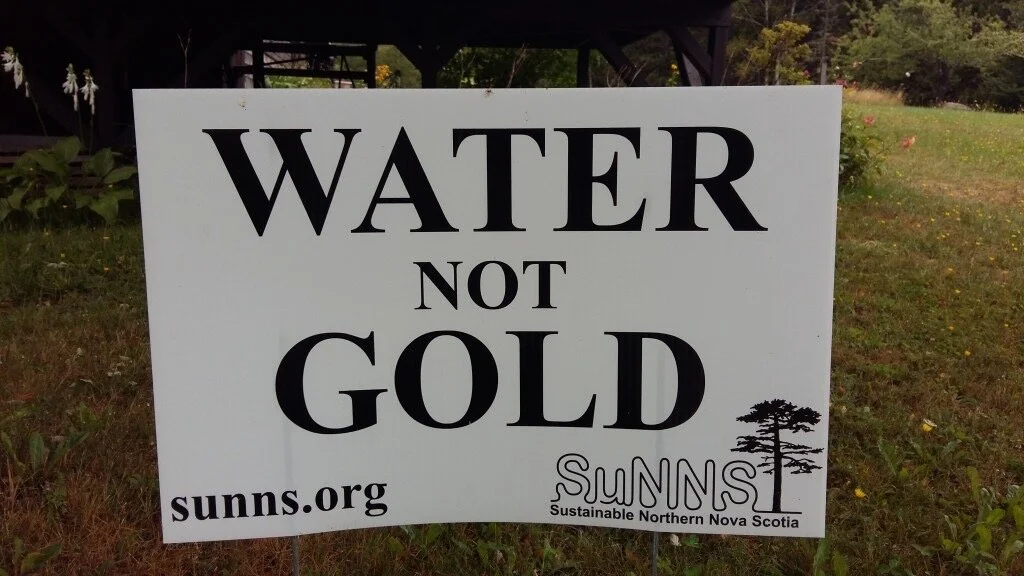
Water Not Gold (Near Tatamagouche, Nova Scotia)

Like Whales #No Pipe (Halifax, Nova Scotia)

No NAPL (Northern Access Pipe-Line) WATER IS LIFE (Buffalo, NY)

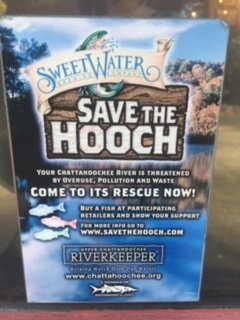
Save the Hooch (Riverkeepers of the Upper Chattahoochee)

Friends of the Reedy River  (Greenville, SC)

Jefferson River Watershed Committee (Montana)

Moab Area Watershed Partnership (Utah)

Elk River Alliance (Fernie, British Columbia)

Delores River Restoration (Rico, CO)

Tomichi Creek Restoration (near White Pine, CO)

The following community efforts are all from Lunenburg, Nova Scotia…

Remember Deep Water Horizon 

One Oil Spill Can Destroy Our Economy

Don’t Be a Fossil Fool 

Offshore Drilling Not Worth the Risk

Other references and valuable resources about our environment.

Secret Knowledge of Water / Atlas of a Lost World: Travels in Ice Age America  by Craig Childs

The Poisoned City: Flint’s Water and the American Urban Tragedy by Anna Clark

“The Trouble with Wilderness; or, Getting Back to the Wrong Nature” (essay) by William Cronon

Pilgrim at Tinker Creek by Annie Dillard 

The Solace of Open Spaces by Gretel Ehrlich

Amity and Prosperity: One Family and the Fracturing of America by Eliza Griswold

Downriver: Into the Future of the Water in the West by Heather Hansmen

Deep Creek by Pam Houston

Braiding Sweetgrass: Indigenous Wisdom, Scientific Knowledge, and the Teachings of Plants by Robin Wall Kimmerer

Unsheltered by Barbara Kingsolver (fiction)

Stand Up That Mountain by Erkskine Leutz

This Land Our Land: How We Lost the Right to Roam and How to Take It Back 

Trespassing Across America by Ken Ilgunes

A Long Trek Home / Small Feet Big Land / Mudflats and Fish Camps by Erin McKittrick

Upstream by Mary Oliver 

Where the Water Goes: Life and Death Along the Colorado River by David Owen

 “Jefferson Rising: A restoration success story” by Tom Reed

The Sun Is A Compass: A 4,000 mile Journey Into the Alaskan Wild by Oline Van Hermert

Dark Waters - produced by Mark Ruffalo based on a New York Times article. (Movie)

A Reflection from Six Months of our Travels

STATING THE OBVIOUS

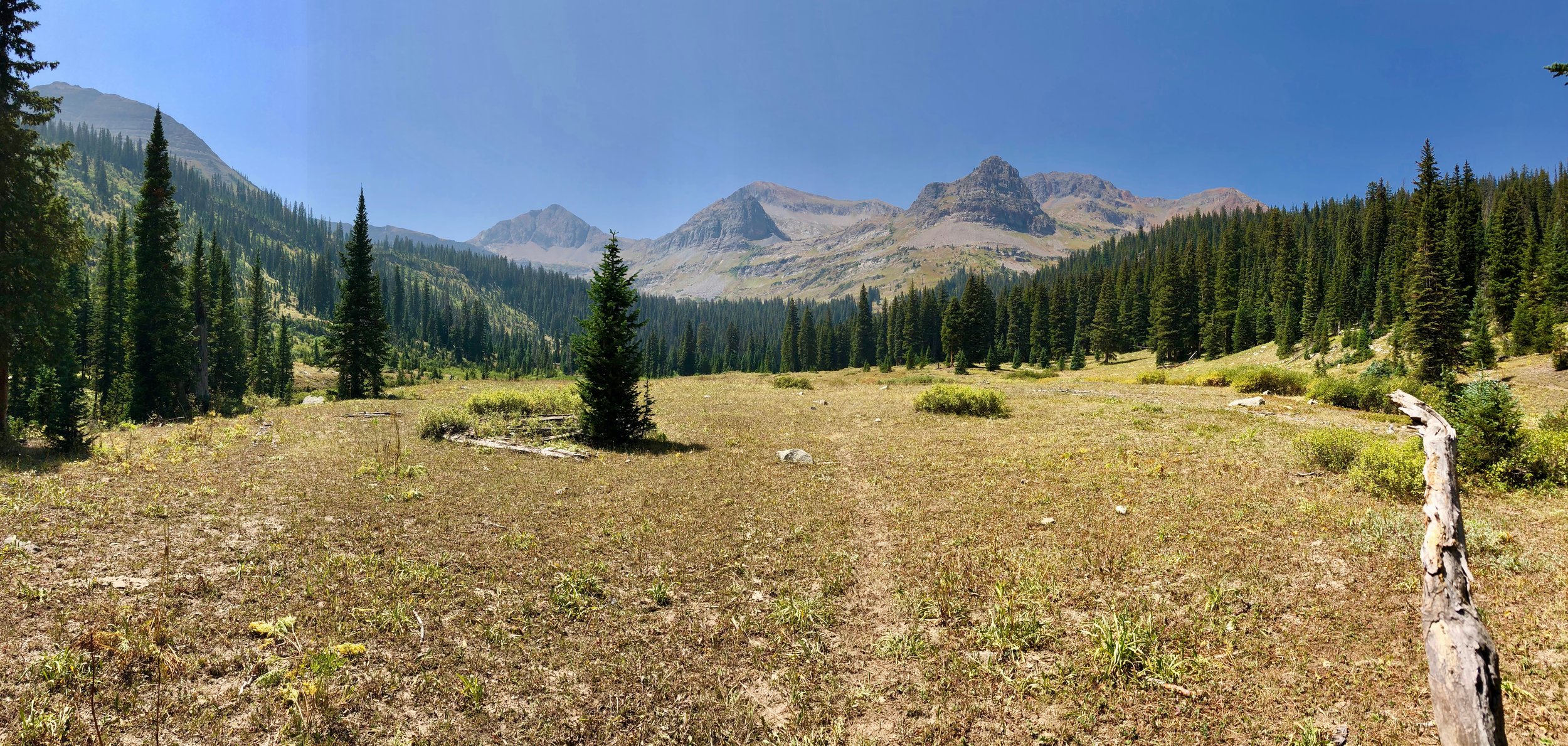
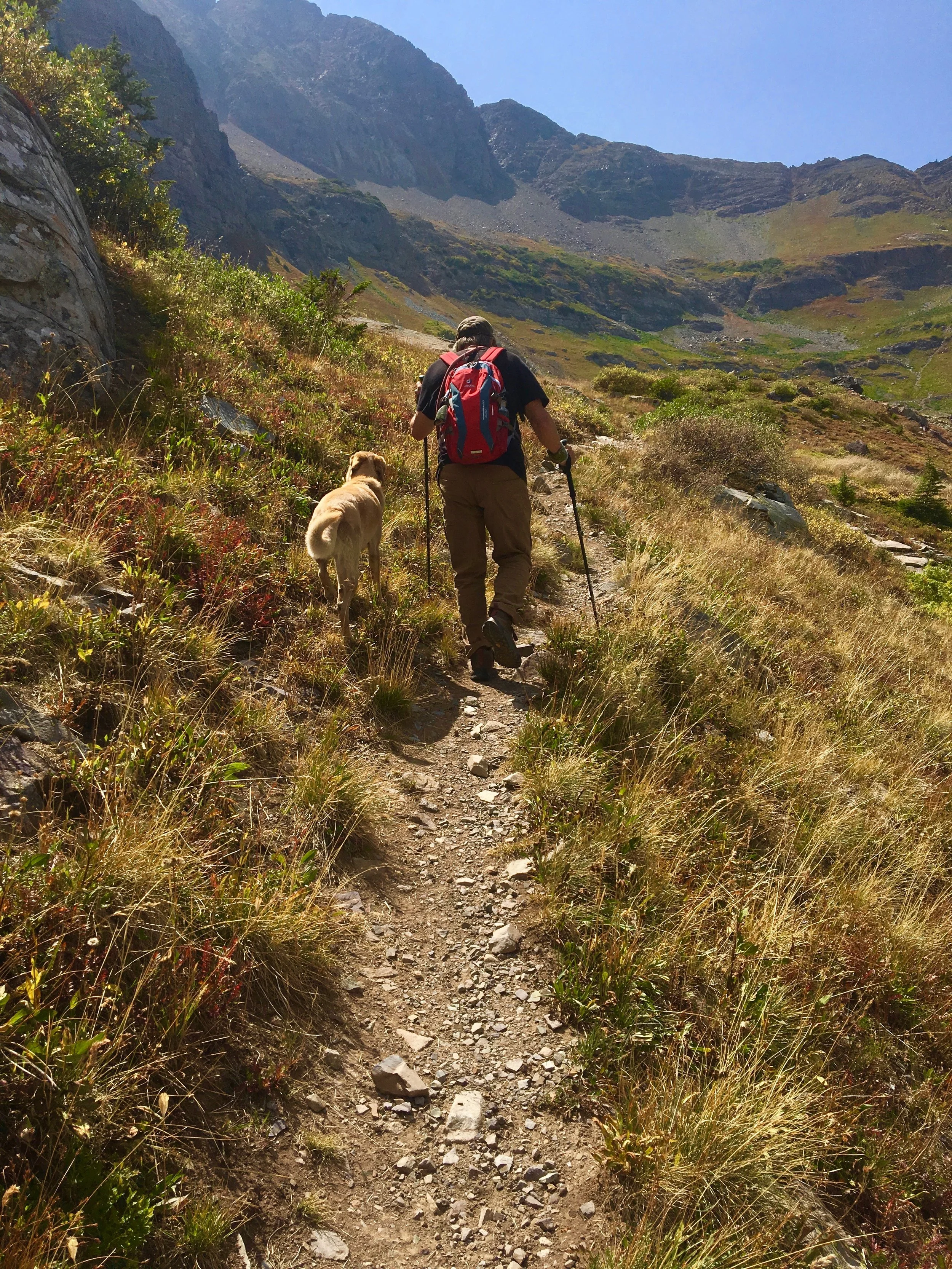
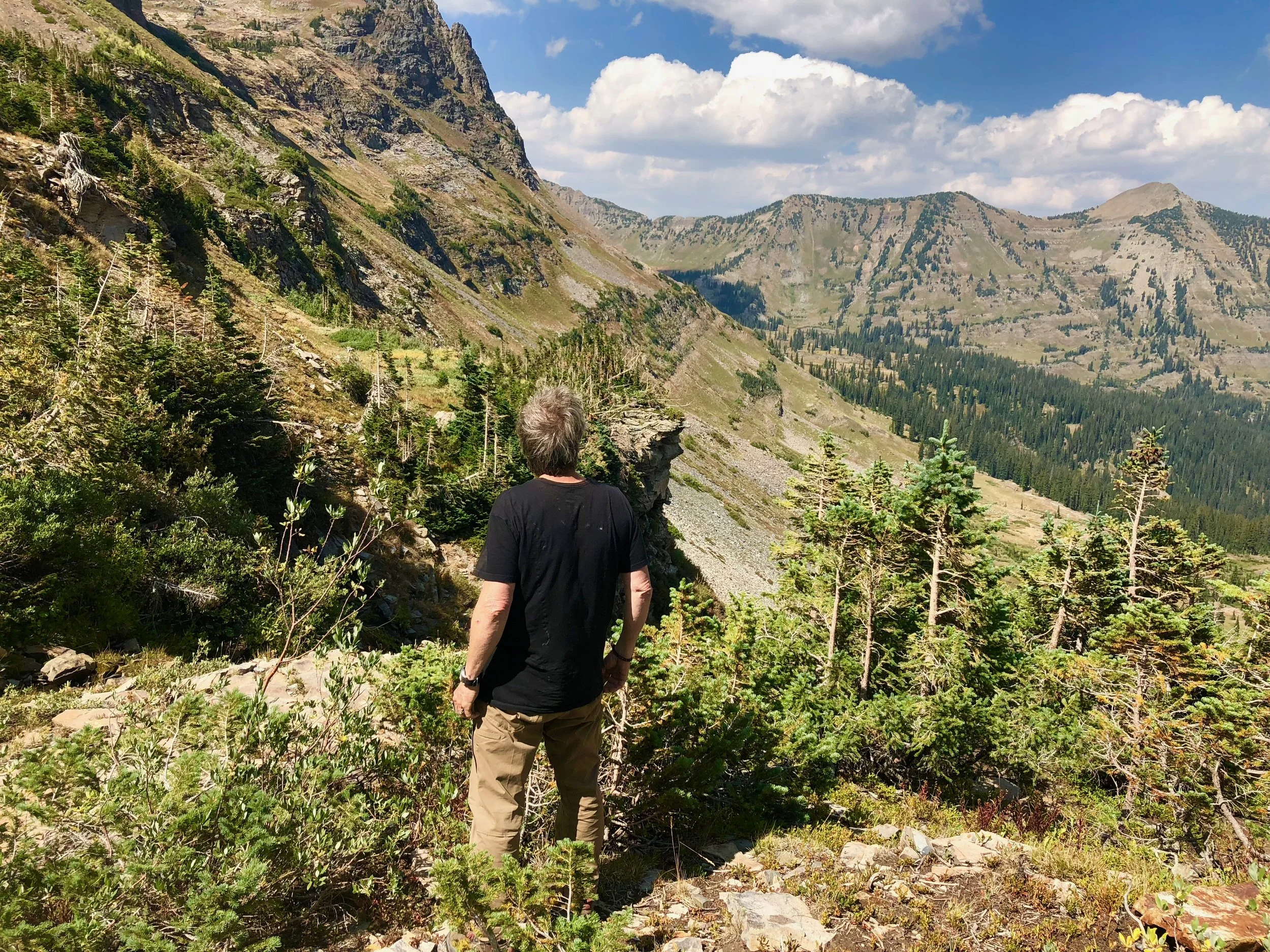
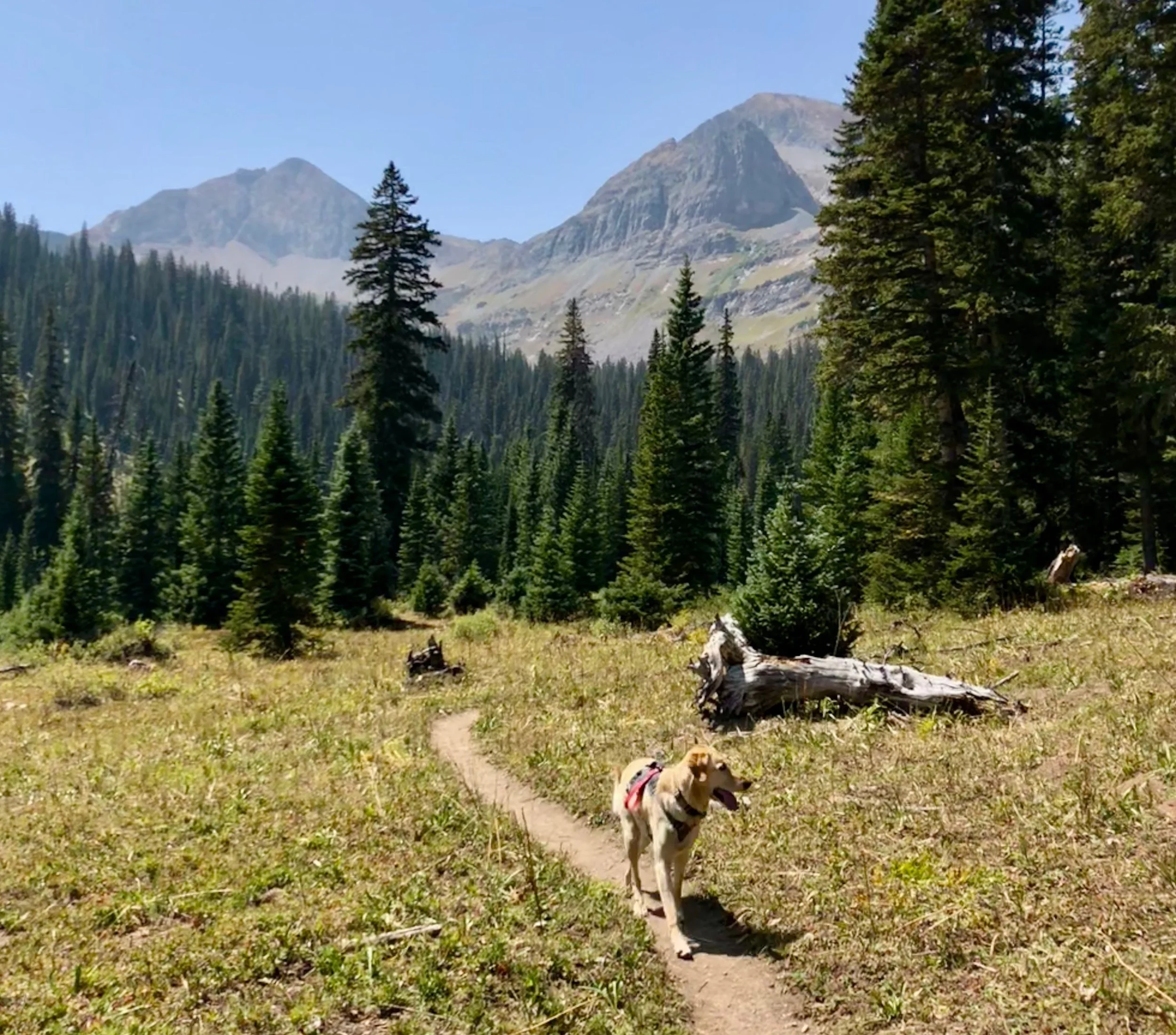
During the last week in August, camping about six miles outside of Crested Butte, Colorado we chose to spend the day hiking the popular “Oh Be Joyful Trail”.  This trail is an eleven mile out and back hike crossing meadows, passing through small forest groves of spruce or aspen, and tracing gentle streams. The trail meanders between two mountain ridges through the beautiful “Oh Be Joyful” valley until it reaches the valley head framed by impressive twelve-thousand foot peaks.  The sky shed its early morning clouds and a serendipitous sun broke through at mid morning when we began. “Oh be Joyful” seemed more and more the fitting epithet for the trail as we hiked… and even now in the late summer, the streams persisted, gently flowing with the occasional stair step falls, small cool pools and end of the summer wild flower bouquets enhancing the familiar aromatic balm of the backcountry. A transcendental trek on a perfect day - clear, crisp, and cool as we began and just beginning to approach a subtle early afternoon warm when we arrived at the turn around point.

Reaching the turnabout we came upon a couple, a man and a woman, rising from their shaded rest at the trail intersect. His Don Quixote like silhouette faded when the man stepped out of the shade revealing his flushed pale skin, roughly hewn chiseled features and silver hair. As he busied himself adjusting his “armor”… the full backpack he was returning to his wiry frame following their rest.  The woman, no squire or foil to this Quixote, instead seemed perhaps more his muse or his inspiration. A knowing wise face, she exuded a much larger presence than her small frame. Her hair haphazardly shoved up under a hat and pack already in place, she stood inhaling to our amusement a couple of short breaths from a small pipe that it was pungently clear had been filled with cannabis. We exchanged with them the amiable greetings in camaraderie that most hikers meeting on a common trail will share.  Yet from this first greeting they talked to us as if they knew us or at the very least were expecting us! As they spoke they were at once both interesting and endearing with the demeanor of a couple that could without pause easily finish one another’s sentences. They radiated a connectedness that made them appear as complimentary to one another as the streams running in sinuous ribbon-like lines across the valley floor are connected to the mountains from where they emanate.  

We assumed at first they had traveled the same route by which we had just come and were, like us, about to turn around to make the trek back… except for the full packs. They explained that they were continuing on the intersecting trail toward the north looking for a place to camp for the night and hoping they would not get rained on…much!  Then very excitedly he began telling us that we should hike on up the trail further as it would lead us to a beautiful, blue alpine lake!  And while he continued to relay excitedly the virtues and wonder of their adventures there, she (agreeing with his descriptions but in her more calm and circumspect manor) described the details of the trail in order for us to find this treasure. They spoke to us with the certainty that it should be our natural inclination to follow their advice. His frantic and comical excitement and her beguiling descriptions clearly had their intended enticing effect as both of us immediately said, “Lets go!” We wished each other well and headed off in different directions…they toward wherever they went next!…and us toward where they had already been!

With an unexpectedly inspired vision of an alpine lake fed to us by these etherial strangers, we continued on the new addition to our hike and our new goal. In jest, we began to question whether or not our guides were in fact real or some strange alpine aberration…mountain ghosts…sent to inspire us to hike toward something special! Passing over meadow, hurdling boulder, wandering through wood, and fording stream, we marked our progress by their foreshadowed trail descriptions and landmarks. When reaching that part of the trail of which we had been warned…the part where the trail grew steeper and more difficult…without pause we just kept hiking!  While we are not novices at hiking and backpacking, for someone of more experience (and a clearly sturdier physique), this would perhaps only be seen as “that steeper section”…but for us hiking at near eleven-thousand feet and perhaps still needing to acclimatize a bit more to the altitude, it felt pretty damn steep!  The trail followed a series of steep switchbacks followed by long straight steep sections…steep sections that as we climbed began to look like a dolly zoom effect in the movies…with each step forward the trail tunneled and pulled away looking longer and longer! We would at last crest a hill or round a curve only to find it was a false peak or there was still another high altitude hairpin to go around…and we were not yet seeing any sign of the lake! But…we kept hiking. To add to the mystery of the now illusive alpine Arcadia was the appearance of a series of different trails disappearing in diverse directions off across the distant tundra. Given the lay of the landscape and our views obscured by rock or hill, we had no way of determining which one of these was the trail we were on and therefore, had much more mountain to traverse!…or had we made a mistake, missed a turn, overlooked a landmark …so…a bit worried… we kept hiking. 

Now the bane to a good trek is doubt. It can at the very least distract you and at worse compromise your decision. I suppose in some circumstances it could even put you in harms way.  It is with good reason hikers are constantly cautioned to trust their instincts as much as they are advised to always be prepared. So while doubt as to whether or not we would find the lake perhaps should have seeped in through our weary steps; and while perhaps concern should have surfaced that if we went too far to reach our goal, we would not be able to make the return trip before nightfall. In our occasional exasperated, expletive filled exclamations of “Where the hell is this lake?”… we had no real desire to stop.  So we simply did what you do in these circumstances…put one foot in front of the other and continue to hike!

“None of your knowledge, your reading, your connections will be of any use here: two legs suffice, and big eyes to see with. Walk alone, across mountains or through forests. You are nobody to the hills or the thick boughs heavy with greenery. You are no longer a role, or a status, not even an individual, but a body, a body that feels sharp stones on the paths, the caress of long grass and the freshness of the wind. When you walk, the world has neither present nor future: nothing but the cycle of mornings and evenings. Always the same thing to do all day: walk. But the walker who marvels while walking (the blue of the rocks in a July evening light, the silvery green of olive leaves at noon, the violet morning hills) has no past, no plans, no experience. He has within him the eternal child. While walking I am but a simple gaze.” 

― Frédéric Gros, A Philosophy of Walking

When you hike…when you are really out in nature, especially the backcountry, and you allow yourself to be immersed in it, you have the opportunity to transcend boundaries.  When we finally paused and let our eyes be drawn away from the steep trail of rocks and roots to take in the broader view of the landscape around us, the view that greeted us was the lifting of a veil. What we became immediately aware of… the epiphany… was the awareness of and connection with…where we were! Where we were was amazing! What we were seeing was grand, majestic and magical. And what we were doing was truly… really, really FUN!

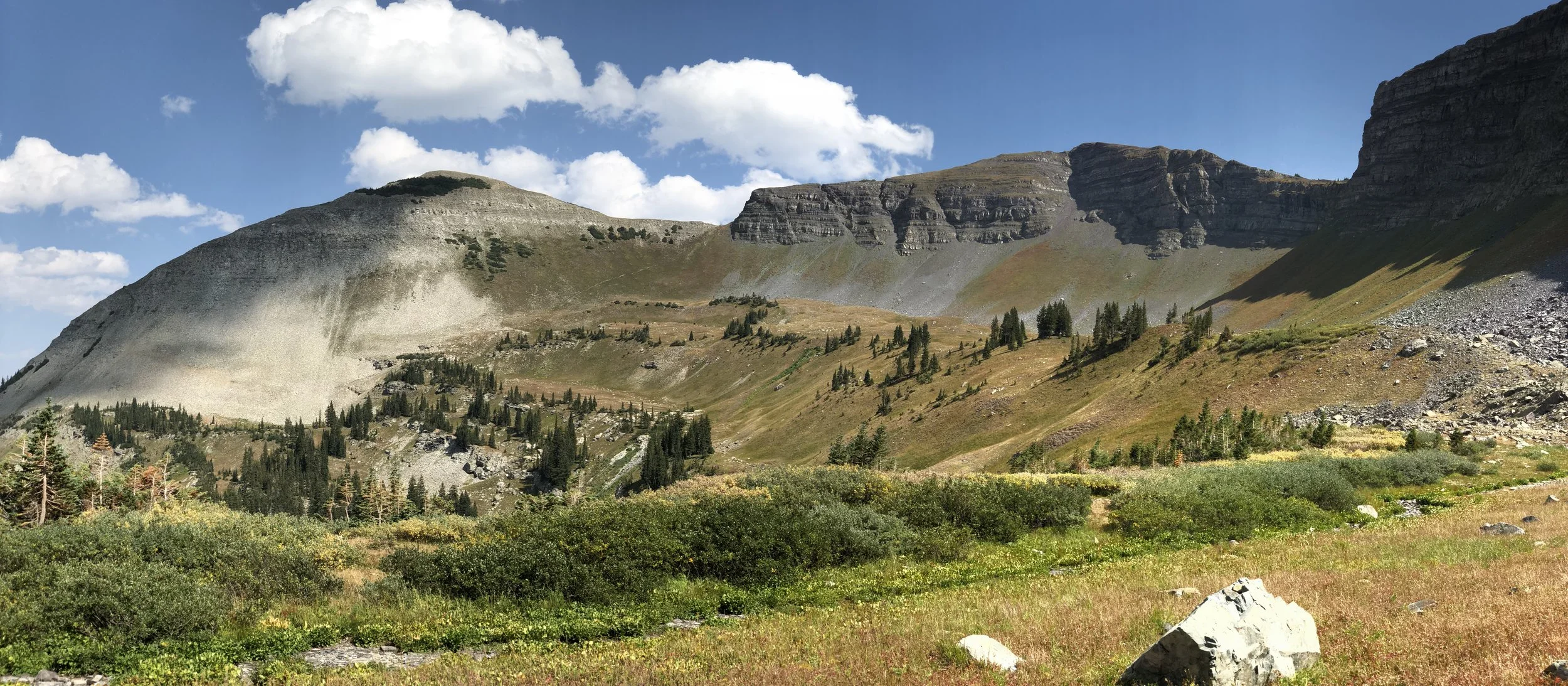
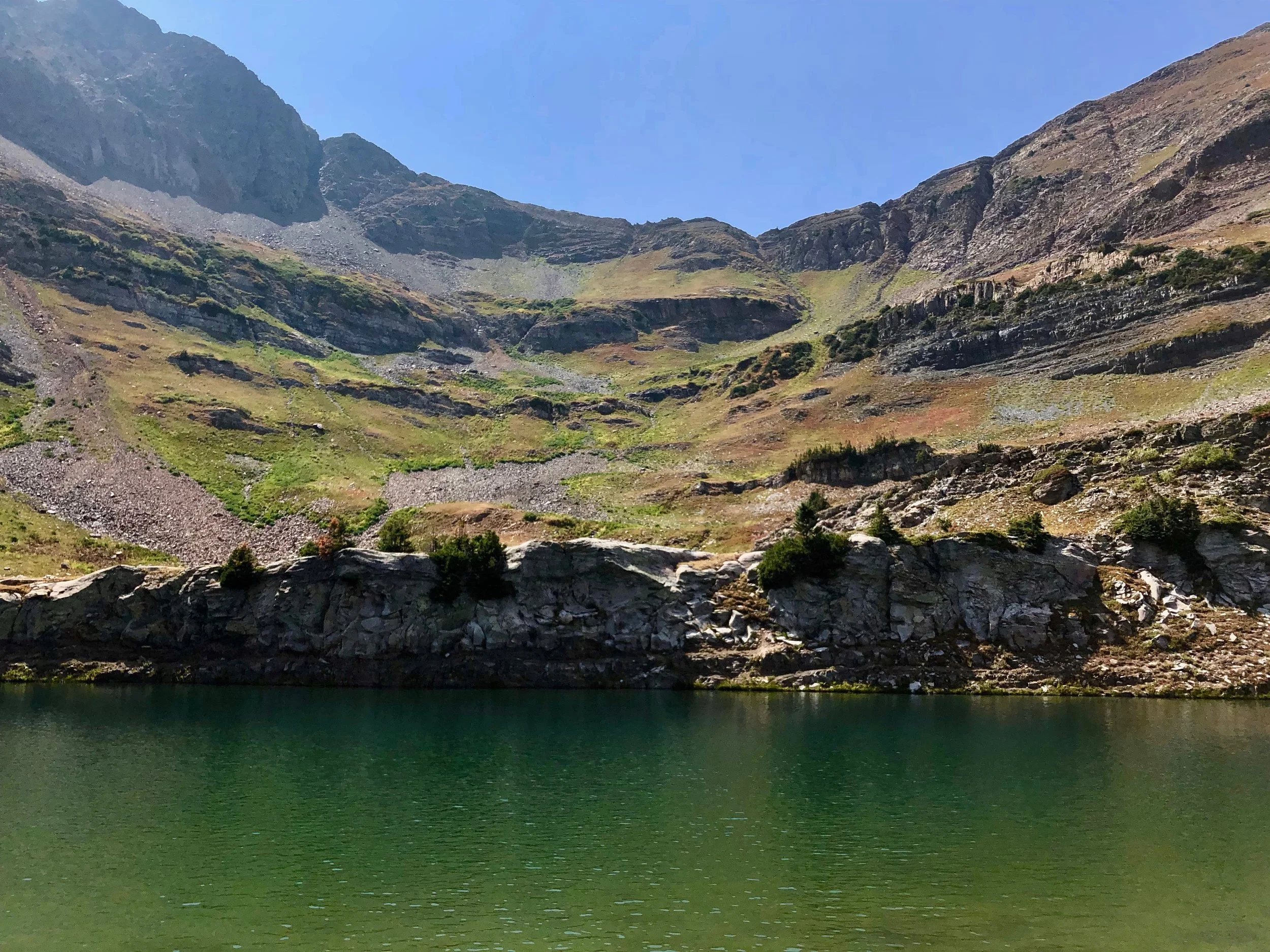
There is always some sort of magic to be seen on a good hike…as when we crested the ridge where our view to the the lake began to unfold like a bloom…expanding and spreading open with each step revealing the mirror blue-green skin of the lake below held in embrace by the twelve-thousand foot Afley Peak and Purple Mountain on its far shore. We were speechless! But not speechless in the sense that we could not talk…in fact we were dizzy with joy and could not stop talking and shouting. What we were saying was a sort of giddy gibberish that has become a common occurrence for us in our travels the last six months…something that we have come to describe as the “stating the obvious speechlessness”. We find ourselves shouting such clever descriptions as….”Look at this!..Look at this!…This is beautiful!” or “This is amazing!” or  “This amazingly beautiful!”… or “This is incredible” or“This is awesome!” or “This is amazingly, awesomely, incredibly beautiful!”, or Holy Fuck!…all we could utter in our ridiculous rambling rants were hackneyed expressions to describe something that was clearly beyond words and so we are left “speechless” to do nothing more than… state the obvious!

Finally we grew quiet…

Sometimes the sublime beauty of a place is such that any personification in words simply cannot get at the roots of the experience.  It is then when the silence often comes…it is then when you become quiet…and you look, and you listen and you can hear and feel a place talk to you… you begin to feel more deeply than one is typically aware of - or just what it is to be alive in a place like this. It is the sort of feeling that germinates and burgeons beyond our practical perception to a level of awareness awakening a symbiotic union. In those moments you are no longer a bystander, a visitor or an observer…you are drawn in… and given a seat at a commensal banquet along side, and holding no less or no greater importance, than the birds, the creatures, the flowers, the trees, the rocks, the stream, the lake, the clouds and the sky. You are nothing more than a piece of the panorama, a part of the landscape. There is no worry, no desire, no fear…instead there is exaltation… and the one taste left on your pallet from this pastoral feast is devotion. 


Time Traveling

“The secret of life is enjoying the passage of time.

Any fool can do it, there ain’t nothing to it.

Nobody knows how we got to the top of the hill.But since we’re on our way down,

we might as well enjoy the ride.” ~James Taylor


We meant to post much sooner…but…

We planned a short stop “off the road” to take care of some unfinished business for a few days…it took longer!

We had planned to visit friends and family but forgot to consider that when you have more free time…it doesn’t always coincide with those who have less…it got complicated!

We  thought we avoided the heat and humidity of the southeast…when we returned it was hot as hell!

We headed toward the east coast of North Carolina…a hurricane came!

We were going to the mountains…we ended up in Florida!…there are no mountains in Florida!

We planned to head northeast…we ended up going south!

We planned to camp and hike in the Pisgah National forest…the hurricane…again (closed campgrounds and hiking trails)!

And finally as we headed in the “right direction” toward  the “right place” driving along pleased with how we had out smarted another storm, we discovered that the storm had already passed!..Somehow in our enlightened road wisdom we apparently had no idea what freaking day it was!!!

One of the things you can always predict in traveling is that the unpredictable will most certainly always have a role to play. 

And so when the phrase “It is what it is” seems at times like nothing more than a dismissive expression too often used to avoid or ignore and too closely related to apathy or simple laziness…we have come to recognize that in travel- it can be a well deserved description and even a “starting point” as to how to begin to deal with an unexpected situation.  It can be a sort of acceptance. Rather than being overwhelmed by frustration or drowning in disappointment, we can perhaps push ourselves to pursue a new course.  Wasting time obsessing over how our time traveling has been unexpectedly altered and our path unpredictably changed is some times a bigger waste of time than the detours, obstacles, impediments, interruptions, and setbacks.

Unpredictability has been that aspect of travel reminding us that travel is not about timetables, schedules, reservations, or itineraries, BUT more about how travel and traveling is a great teacher of how to live in the moment.

For every unexpected turn in the road we have encountered that could be seen as a setback, there have been opportunities created as well.  An unexpected stop introduces us to someone who recommends a memorable place that we otherwise would not have known about. Delays have given us the opportunity to spend more time with family and friends or introduce us to new friends. A flat tire or mechanical issue reminds us of the kindness of strangers. Detours make us slow down, observe more, and take a path less traveled.  And lest we forget…this entire journey of ours grew out of an unexpected change in plans!  We originally planned to attempt a thru-hike of the Appalachian Trail this year, but after a formidable back-country hike in Colorado last year that shall I say, kicked our butt! …we decided a year on the road traveling and hiking might help us prepare more for that adventure further down the road. Perhaps, most importantly, these situations remind us to be patient, and encourage us to intentionally alter our path from time to time to experience something new. 

So in many respects, travel is as much about time as it is about place.  It is after all about how one spends their time.  If the expression “the journey is the destination” is to have any genuine meaning then it seems only prudent to understand it’s connection to time. We are learning in our travel that it has much less to do with how time passes and more to do with how we pass through time. This is how our travel turns us into time travelers!

“To finish the moment, to find the journey's end in every step of the road, to live the greatest number of good hours, is wisdom.” ~Ralph Waldo Emerson


Jim & Anne

We're on a Road to Somewhere

Dirty dusty if it is dry, and messy muddy if wet, the road to McCarthy is hard. It is 60 miles of rocks, gravel, dirt, broken pavement, pot holes, landslides, frost heaves, and the occasional railroad spike. The repetitive washboard ridges in the road left by the tracks of the bulldozers and road graders are the worse. They create a chattering  that builds and builds. But rather than reaching a spine jarring crescendo (like the myriad of potholes you dodge and weave to avoid, but sooner or later hit), they just continue in a seemingly endless teeth chattering, jackhammer shake that won’t stop…until it’s ready!…and it is always too long! 

After 3 hours of traversing mountain passes, crossing over streams, and rivers, circumnavigating lakes, and wetlands, and passing through meadows with most of the journey enveloped in a maze of boreal forest, you reach the end of the road.  Here you will find a small host of cabin rentals, and primitive campgrounds where you can set up camp before crossing the bridge over the Kennicott river and walking the last half mile into the town of McCarthy.  Another  4 1/2 miles further will bring you to the abandoned mining town of Kennicott.  These unique places lie just below the Kennicott and Root Glaciers and are surrounded by the Wrangell mountains…a mountain range that holds some of the highest peaks in North America.  McCarthy lies on the edge of…while Kennicott is within the borders of and is managed by… the Wrangle-St. Elias National Park.  This lesser known park is actually the largest National Park in the United States encompassing over 20,000 square miles!  Of course there is an easier way!… you can opt to fly into McCarthy on a chartered bush pilot flight and have you and your luggage ferried by van shuttle to a small hotel in McCarthy or to a lodge in Kennicott…but where’s the fun and adventure in that?!  

While it has grown in tourist popularity, McCarthy remains small and relatively unchanged. Perhaps because it is so remote. Boasting a couple of restaurants, a handful of other shops, and adventure sports guides, its population of about 80 in the summer shrinks to less than 30 the remainder of the year with temperatures occasionally reaching lower than 30 below zero! By Alaska’s standards perhaps McCarthy isn’t that remote!…after all there is a road to it!

 But Alaska is a state that is mostly inaccessible except by bush plane or boat and only has a dozen “highways”!  It is ridiculously big!   As Mark Adams describes in his book Tip of the Iceberg - “Alaska is essentially a small continent: big enough to hold Texas, California, and Montana (the second- third- and fourth largest states) and still have room left over for New England, Hawaii, and a couple of metropolises.  It contains seven mountain ranges and ten peaks taller than any in the Lower 48.  Its waterfront accounts for half of all the coast in the United States. Louisiana has four times as many miles of paved roads.”  Alaska is crazy!  

So then, what is the point in traveling over 8,000 miles to end up sitting at an old abandoned copper mine on the edge of a glacier’s terminus with a special gifted bottle of wine, a loaf of bread, some cheese, and some dark chocolate, and to stare out at the permafrost, wild flowers, the glacial fed river, and the snow capped mountains?

Because it is sublime.  Because it is still a place that holds some purity. Because if not completely uncorrupted it is at least less corrupted. Because it troubles me that as William Cronon said in his essay The Trouble with Wilderness, we find ourselves in the position that “we have little hope of discovering what an ethical, sustainable, honorable human place in nature might actually look like”. Because it was real.  And because the journey had meaning….it required effort to come to this place. 

We are learning that while it is increasingly difficult to find places that create an awe because of their wild not their wilderness,  that they exist. To experience them is attainable, but it requires effort. It is sitting quietly in the sublime that one begins to see the depth of what we are overlooking out of our simple lack of effort.

In Thoreau’s essay Walking, he forewarned much of where we are in our relationship with nature and our access to it. Thoreau said “Possibly the day will come, when land will be partitioned off…in which a few will take a narrow and exclusive leisure only.  When fences shall be multiplied, and man-traps and other engines invented to confine men to the public road…Let us improve our opportunities, then, before the evil days come.”

Read More

THE TURNAGAIN ARM

“We desire not merely to know the sorts of things that are revealed in scientific papers but to know what is beautiful and edifying in a faraway place….

The land retains an identity of its own, still deeper and more subtle than we can know.  Our obligation toward it then becomes simple: to approach it with an uncalculating mind, with an attitude of regard.”

~Barry Lopez, Arctic Dreams


Today the clouds and the rain have created a filtered light that moves the rich summer greens here to become intensely deep… lush, opulent, succulent greens that look as if the source of the color is not the cones in our eyes reflecting waves of white light but rather the hues  revealing themselves as separate living things inside the plants.

We are camped at the edge of an expanse of grasses in Hope, Alaska on the Turnagain Arm - a large inlet of the Gulf of Alaska in the north of the Kenai peninsula.  If we are fortunate, we may have the opportunity to witness a tidal bore…the rushing of a true tidal wave as it pushes opposite against the flow of a river emptying into the sea. This is one of the few places in the world where this phenomenon occurs.  Our desire to witness this unique, natural event pales in comparison to the level of anticipation and drinking at the nearby SeaView bar by locals and the countless fisherman anxiously waiting for the rush of the salmon-run up the nearby Resurrection Creek…which we are told, could happen any day now! 


The image of the mountain in the golden hour light of an afternoon is awe inspiring, but it rarely captures the sense of presence the mountain imbues you with when breathing in its humbling sense of scale and listening to its song. 

While a photograph perhaps can capture a moment, inspire awe, motivate, evoke, inform, and enlighten… striking images of exquisite panoramas are a plagiarized perspective of travel….they borrow the beauty, steal the setting, and pirate the place, but they cannot take the place of the experience. They cannot capture what Barry Lopez (Arctic Dreams) refers  to as the invisible landscape - the stories, the myths, the people, the vision…that make up the real landscape…the cultural landscape.

We have been traveling for over a month and have driven over eight thousand miles.  There is a distinct difference between those two facets.  The eight thousand miles driving is often on some level simply a meditative way of moving from place to place. It is filled with anticipation, surprising turns, long conversations, silly songs, quiet reflection, occasional frustrations and more scenery than we can begin to explain!  The travel is the countless stories that unfold as we move or depending on perspective - a story.  It is the experiences, serendipitous encounters, revealing of nature, and the overwhelming sense of humility that begins to seep its way into all the cracks often created in all of us over the years by expectations of what we think we are supposed to think, do, and be.  Travel is our new school and our new studio. We are just getting started.  We sincerely appreciate the well wishes while we are on our “trip”… and we are grateful for the hopes and prayers that our journey will return us “home” safely…but… this is not just a trip, and we are home!

~ Jim and Anne